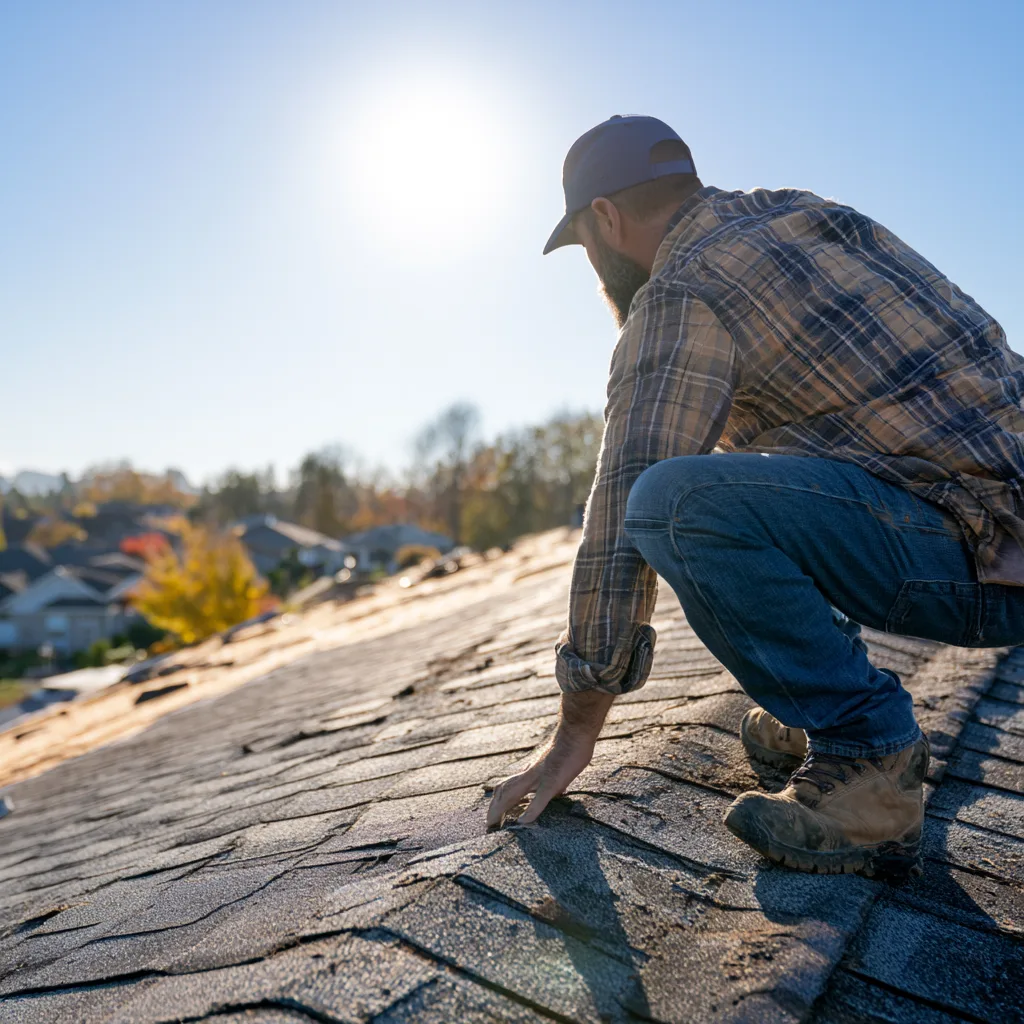
The house may have a build date on every listing and no reliable date for the roof above it. If you inherited the covering when you bought the home, that gap is understandable. Installation records can establish its age; an inspection can establish its condition. You can make a sensible roof decision even when the first answer stays uncertain.
Start with a record of completed roof work
An invoice for a completed replacement is more useful than the date someone quoted the job. Look for the property address, the work described and the completion date. A receipt for a small leak repair doesn't establish when the whole roof was installed, and a price for replacement doesn't establish that the work happened.
Your purchase paperwork may contain the previous owner's disclosure, a roof invoice or an inspection report. An inspection report's age estimate is still an estimate unless it points to an installation record. A prior roof insurance claim may help narrow the history, but the date of a storm or claim isn't automatically the date of a new roof.
If a previous owner remembers a year but has no paperwork, keep that distinction. 'The seller recalled replacement around 2014' is more useful than turning 2014 into an exact installation date. You don't have to solve the whole paper trail before asking a roofer to look.
One house can have more than one roof age
A garage addition, a replaced back slope or an older porch covering can leave different parts of a house with different histories. A document that says 'new roof' needs enough detail to show which parts it covered. That matters when someone treats the youngest section as the age of everything overhead.
Layers complicate the question as well. If shingles were installed over an older covering, the visible surface and the material underneath didn't start together. Flashing and other details may also have been retained during earlier work. A roof inspection can identify reasons to ask about that history; it shouldn't turn one visible detail into a made-up installation date.
The useful outcome is a clearer description of the roof you have: what the records establish, which sections differ and where the age is still unknown. That is a better starting point than a single confident number with no basis.
Wear shows condition more clearly than a calendar year
A roofer examines the granule covering, cracked or curling shingles, exposed edges and the condition of flashing where the roof meets a wall, chimney or vent. Those details help explain whether the covering is protecting the house and whether a repair can connect to sound material.
They don't all age at one rate. Sun exposure, drainage, the shingle itself and past damage affect how a slope wears. Shingles also become more brittle as their asphalt ages, so the ability to lift surrounding shingles without breaking them matters when planning a repair.
That is why a roof can look older on one side than the other. A walk can produce an informed assessment of condition, but the surface alone doesn't reliably reveal the year it was installed. When the date is unknown, the honest answer stays an estimate rather than becoming a precise age because someone took a closer look.
How long should an asphalt roof last?
For broad planning, think in terms of roughly 20 to 30 years across common asphalt shingle types, rather than treating every shingle as the same product. InterNACHI's general life-expectancy chart lists about 20 years for three-tab shingles and 30 for architectural shingles. Those are general estimates, not a measured Norman average or a promise about your roof.
Storm damage, installation and maintenance can shorten the useful life. A warranty labeled 'lifetime' doesn't turn that planning span into a guarantee that the covering will last as long as the house. It describes coverage under the manufacturer's terms. Our shingle options guide explains the products; the warranty guide explains the different promises attached to them.
The material changes the planning horizon, too. The same general chart gives metal a much wider 40-to-80-year range. A metal roof still has connections and details that need attention. Its broad range doesn't date an existing roof or excuse a leak.
In Norman, the weather belongs beside the age
A recent installation date doesn't rule out storm damage. An older date doesn't prove every slope is worn out. Hail and wind affect the condition of the covering, while a calendar measures only the time since installation. They answer different questions.
If a storm is part of the roof's history, mention it during the inspection conversation. Our hail damage repair page explains what a roof check can establish. A nearby report alone can't identify damage on your house, and an inspection can't reliably assign every mark to one particular storm.
When the covering is still suitable for a focused repair, age is useful background rather than a reason to discard it. When wear is widespread, the replacement discussion should explain the condition and work involved. Neither decision needs to be made from the house's build year.
Get help with the question you actually have
If you're unsure whether an unfamiliar roof needs attention, say that. Norman Peak Roofing offers a free inspection, with a roofer walking the roof to look at what is there now. You can bring any records you already have, but finding old paperwork isn't a condition of asking for help.
If an insurer or buyer is requesting a particular report, ask what they require before arranging it. A free roof inspection shouldn't be assumed to include an insurer's certification, a written remaining-life estimate or a formal report for a sale.
Age questions Norman homeowners bring up
Does a roof have to be replaced when it reaches 20 years?
The birthday alone doesn't decide the roofing work. The covering's condition, damage and repair needs matter. An insurer can have separate underwriting requirements for an older roof, so discuss a coverage notice with your insurance company rather than treating it as a roof diagnosis.
Can a roofer tell the exact age without paperwork?
Usually the useful answer is an estimate, not an exact installation year. A roof inspection can assess present condition even when no reliable date survives. Ask what any age estimate is based on.
Does a previous owner’s warranty come with the house?
It depends on the written warranty, its transfer conditions and whether any required steps were completed. Get the actual document before relying on remaining coverage. Material and workmanship warranties can have different transfer terms.
Does an old insurance claim prove the roof was replaced?
No. A claim can relate to a repair, a partial replacement or work that wasn't carried out. The completed invoice or other record of the actual work is what connects the claim history to the covering on the house.